IMP Questions लेबलों वाले संदेश दिखाए जा रहे हैं. सभी संदेश दिखाएं

Chemical Reaction and Equation

Class 10th science
HOTS
Chemical Reactions and Equations
1.  What is a redox reaction?
2.  What is corrosion? Explain its advantage and disadvantage.
3.  What is rancidity? How can we reduce the problem of rancidity?
4.  How is corrosion different from rusting?
5.  What is meant by endothermic and exothermic reactions? Give suitable example for each.
6.  Define different types of chemical reaction and give examples for each.
7.  Why is photosynthesis considered as an endothermic reaction?
8.  In electrolysis of water, why is the volume of gas collected over one electrode double that of the other electrode?
9.  What happens when water is added to solid calcium oxide taken in a container? Write a chemical formula for the same.
10.  Give one use of quick lime.
11.  Give three types of decomposition reaction.
12.  Name the compound used for testing CO2 gas.

Carbon and it's compound

1.   (a) Complete the following equations:
             
        (b) Write the name of the following:
               (i) CH3CH2COOH (ii) CH3CH2Br
        (c) Draw the electron dot structure of ethene (C2H4).
(CBSE 2008 C)
2.   (a) Name the compound CH3CH2OH and identify its functional group.
        (b) Give a chemical test to distinguish between ethanol and ethanoic acid.
        (c) Name the product formed when an organic acid reacts with an alcohol in presence of an acid catalyst. What is the name assigned to this type of reaction?
(AI CBSE 2008 C)
3.   (a) Name the compound CH3COOH and identify its funcational group.
        (b) Give a chemical test to identify this compound.
        (c) Name the gas evolved when this compound acts on solid sodium carbonate. How would you identify this gas?
4.   (a) Give a chemical test to distinguish between saturated and unsaturated hydrocarbons.
        (b) (i) Name the products formed when ethanol burns in air.
               (ii) What two forms of energy are liberated on burning alcohol?
        (c) Why is the reaction between methane and chlorine considered a substitution reaction?
(AI CBSE 2008 C)
5.   Give reason for the following observations:
        (a) The element carbon forms a very large number of compounds.
        (b) Air holes of a gas burner have to be adjusted when the heated vessels get blackened by the flame.
        (c) Use of synthetic detergents causes pollution of water. (CBSE 2009)
6.   (a) What is vinegar?
        (b) Describe with a chemical equation, what happens when sodium hydrogen carbonate reacts with ethanoic acid.
7.   (a) Write the names of the functional groups in:
             
        (b) Describe a chemical test to distinguish between ethanol and ethanoic acid.
        (c) Write a chemical equation to represent what happens when hydrogen gas is passed through an unsaturated hydrocarbons in the presence of nickel as a catalyst.
(CBSE 2009 F)
8.   (a) Why does carbon form compounds mainly by covalent bonding?
        (b) List any two reasons for carbon forming a very large number of compounds.
        (c) An organic acid ‘X’ is a liquid which often freezes during winter time in cold countries, has the molecular formula, C2H4O2. On warmong it with ethanol in the presence of a few drops of concentrated sulphuric acid, a compound ‘Y’ with a sweet smell is formed.
               (i) Identify ‘X’ and ‘Y’.
               (ii) Write a chemical equation for the reaction involved. (CBSE 2008)
9.   (a) What is homologous series of compounds? List any two characteristics of a homologous series.
        (b) (i) What would be observed on adding 5% solution of alkaline potassium permanganate solution drop by drop to some warm ethanol taken in a test tube?
               (ii) Write the name of the compound formed during the chemical reaction.
        (c) How would you distinguish experimentally between an alcohol and a carboxylic acid on the basis of a chemical property?
(CBSE 2008)
10.   (a) What is a functional group in a carbon compound? Identify the functional group present in CH3COOH and C2H5OH.
        (b) State the principle on which the cleansing action of soap is based.
(CBSE 2008)
11.   (a) What is homologous series? Give one example.
        (b) What will happens if ethanoic acid reacts with ethanol in the presence of an acid as a catalyst?
        Name the reaction. Write the chemical reaction for this reaction.
        (c) Why are soaps ineffective in hard water?
(CBSE 2008 C)
12.   (a) Distinguish between esterification and saponification reactions of organic compounds.
        (b) With a labelled diagram describe an activity to show the formation of an ester.
(AI CBSE 2009)
13.   (a) The structural formula of an ester is
             
               Write the structural formula of the corresponding alcohol and the acid.
        (b) (i) Mention the experimental conditions involved in obtaining ethene from ethanol.
               (ii) Write the chemical equation for the above reaction.
        (c) Explain the cleansing action of soap.
(CBSE 2009 F)

Carbon and It's compound

1.   Name two allotrapes of carbon.
2.   Why covalent compounds have low melting and boiling points?
3.   Give two properties of ethanol.
4.   What are heteroatoms?
5.   Define catalyst.
6.   Name the peculiar/specific chemical property exclusive in case of saturated hydrocarbons and unsaturated hydrocarbons.
7.   Why does carbon forms large number of compounds?
8.   Write the structural formula for brompentane and ethanoic acid.
9.   How does ethanoic acid react with carbonates and hydrogen carbonates? Show it with the equation.
10.   Draw the structures of two isomers of butane.
11.   Differentiate between saturated and unsaturated hydrocarbons. Give one example for each.
12.   Diamond and graphite show different physical properties although they are made up of carbon and shows same chemical properties. What is the property called?
13.   What is denatured alcohol?
14.   What is esterification and give its uses?
15.   Give difference between soap and detergent.

Acid bases and salt

1. How will you test for a gas which is liberated when HCL reacts with an active metal? (CBSE 2008)

2. What is baking powder? How does it make the cake soft and spongy? (CBSE 2008)

3. When fresh milk is changed into curd will its pH value increase or decrease? Why?

4. Give Arrhenius definition of an acid and a base. (CBSE 2009)

5. What happens chemically when quick lime is added to water? (CBSE 2008)

6. Name the gas evolved when dilute HCL reacts with Sodium hydrogen carbonate. How is it recognized? (CBSE 2008)

7. How does the flow of acid rain water into a river make the survival of aquatic life in the river difficult? (CBSE 2008)

8. How is the pH of a solution of an acid influenced when it is diluted? (CBSE 2008 F)

9. How does the pH of the solution change when a solution of base is diluted? (CBSE 2008 F)

10. Arrange these in increasing order of their pH values- NaOH, blood, lemon juice. (CBSE 2008 F)

11. Two solutions of A and B have pH values of 5 and 8. Which solution will be basic in nature? (CBSE 2008 C)

12. Why does tooth decay start when pH of mouth is lower than 5.5? (CBSE 2009)

13. What would be the colour of litmus in a solution of sodium carbonate? (CBSE 2009)

14. Name the products obtained when sodium hydrogen carbonate is heated. Write the chemical equation for the same. (AI CBSE 2009)

15. Write the chemical formula of washing soda and baking soda. Which one of these two is an ingredient of antacids? How does it provide relief in stomachache? (CBSE 2008 F)

16. What do you mean by �water of crystallization� of a substance? Describe an activity to show that blue copper sulphate crystals contain water of crystallization. (CBSE 2009 F)

17. How can washing soda be obtained from baking soda? Name an industrial use of washing soda other than washing clothes. (AI CBSE 2008)
18. Why does 1 M HCL solutions have a higher concentration of H+ ions than 1M CH3COOH solution? (AI CBSE 2009)

Acid Bases and Salt

1.  Why is Plaster of Paris stored in a moisture proof container?
2.  What do you mean by neutralization reaction? Give two examples.
3.  Mention two uses of baking soda and washing soda.
4.  Why does a milkman add a small amount of baking soda to fresh milk to shift the pH of fresh milk from 6 to slightly alkaline?
5.  Why do acids not show acidic behavior in the absence of water?
6.  Rain water conducts electricity but distilled water does not. Why?
7.  Why don’t we keep sour substances in brass and copper vessels?
8.  What is the common name of CaOCl2?
9.  Name the compound used for softening hard water.
10.  What happens when baking soda is heated?
11.  Give the properties and uses of bleaching powder.
12.  Give a few uses of acids, bases and salts respectively.

Life processes

1.  In human alimentary canal, name the site of complete digestion of various components of food. Explain the process of digestion. [CBSE (CCE) 2012]
2.  List in tabular form, three differences between arteries and veins. [CBS (CCE) 2012]
3.  List the three kinds of blood vessels of human circulatory system and write their functions in tabular form. [CBSE I CCE) 2012]
4.  (a)  "The breathing cycle is rhythmic whereas exchange of gases is a continuous process". Justify this statement.
      (b)  What happens if conducting tubes of circulatory system develops a leak? State in brief, how could this be avoided?
      (c)  How opening and closing of stomata takes place? [CBSE (CCE) 2011]
5.  Draw a diagram of the front view of human heart and label any six parts including at least two that are concerned with arterial blood supply to the heart muscles. [CBSE (CCE) 2011]
6.  Describe in brief the function of kidneys, ureters, urinary bladder and urethra. [Foreign 2010]
7.  Explain the process of breakdown of glucose in a cell
      (i)   in the presence of oxygen,
      (ii)  in the absence of oxygen. [HOTS,Foreign 2010]
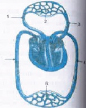
8.  (i) Label any 4 parts in the given diagram.
      (h)  What are the two functions represented in this diagram?
[HOTS, CBSE Sample Paper 2009]
9.  What is double circulation in human beings? Why is it necessary?
[HOTS, NCERT, Delhi 2008C]
10.  (a)  Name two different ways in which glucose is oxidised to provide energy in various organism.
        (b)  Write any two differences between the two oxidation of glucose in organisms. [Al 2008]
11.  Write any three differences between aerobic and anaerobic respiration. [HOTS, NCERT Exemplar, NCERT, AI 2008]
12.  (a) Name the process by which autotrophs prepare town food.
        (b)  List the three events which occur during this process.
        (c)  State two sources from which plants obtain nitrogen for the synthesis of proteins and other compounds. [Foreign 2008]

Life Processes

1.  How is ‘respiration’ different from ‘breathing’? Explain the process of aerobic and anaerobic respiration.
2.  I)     Name the blood vessel that brings oxygenated blood to the human heart.
      II)    Which chamber of the heart received oxygenated blood?
      III)  Explain how is the oxygenated blood from this particular chamber sent to all the body parts?
3.  Explain the schematic representation of gaseous exchange in tissues.
4.  Compare the functioning of alveoli in the lungs and nephrons in the kidneys with respect to their structures and functioning?
5.  What is the significance of emulsification of fats?
6.  Why is the small intestine in herbivores larger than in carnivores?
7.  What is the advantage if a four chambered heart?
8.  Explain the process by which inhalation occurs during breathing in human beings?

Our Environment

1.  What is bad ozone?
2.  Differentiate between natural and artificial ecosystem.
3.  Why are plastic bags non-biodegradable?
4.  Name two decomposers and two producers.
5.  Why are pesticides considered as pollutants despite being useful to the farmers?
6.  Name two artificial eco-system.
7.  What is the role of consumers in the food chain?
8.  Give one advantage and one disadvantage of ozone.
9.  What is an ecosystem? Mention its components.
10.  Difference between biodegradable and non-biodegradable substance.
11.  Why are green plants called producers?
12.  What are the two main components of our environment?

Management of Natural resources

1.   List two traditional system of water harvesting. (CBSE 2008 F)
2.   List four changes you would incorporate in your life cycle in a move towards sustainable use of available resources. (AI CBSE 2008,2009 F)
3.   State two reasons of each of conserving(AI CBSE 2008)
       a. Forest
       b. Wild life
4.   What are natural resources? State two factors that work against an equitable distribution of these resources. (AI CBSE 2009)
5.   Why must we conserve our forests? List any two causes for forestation taking place. (AI CBSE 2009)
6.   What is Chipko Movement? Why should we conserve forests? (AI CBSE 2009)
7.   List four advantage of water harvesting. (AI CBSE 2009)
8.   How do advantages of exploiting natural resources with short term aims differ from the advantages of managing our resources with a long term perspective? (CBSE 2009 F)
9.   What is wild life? How is wild life important for us? ( CBSE 2009 F)
10.   List any two causes of our failure to sustain availability of underground water. (CBSE 2009)

Management of Natural Resources

1.   Define biodiversity.
2.   Name the bacteria whose presence in the water indicates its contamination with disease causing microbes.
3.   Name the place where �Chipko Andolan� organized.
4.   Name the gas responsible for global warming.
5.   Who started Chipko Movement?
6.   Why do we need to use resources carefully?
7.   Prejudice against the traditional use of forests has no basis. Comment.
8.   Which is better rcycle or reuse? Give reason with example.
9.   Give three measures that can lower the use of coal and petroleum.
10.   What is rain water harvesting? How can it be done at local level? What are the benefits?

How do Organisms Reproduce

1.   Name two plants that are grown by vegetative propagation. (CBSE 2016)
2.   What is reproduction? Explain two advantages of sexual reproduction over asexual reproduction (CBSE 2016)
3.   What is reproduction? Mention the importance of DNA copying in reproduction. (CBSE 2008)
4.   List any two differences between pollination and fertilization. (CBSE2008)
5.   Name two sexually transmitted disease caused due to infection and viral infection. How it can these be prevented? (AI 2008)
6.   Explain the terms:
       a. Implantation
       b. Placenta
       c. What is the average duration of human pregnancy? (CBSE 2009)
7.   Why is DNA copying is an essential part of the process reproduction? (AI 2009)
8.   List any four methods of contraception used by humans. How does their use have a direct effect on the health and prosperity of a family? (CBSE 2015)
9.   Define the terms pollination and fertilization. Draw a diagram of a pistil showing pollen tube growth into the ovule and label them:
       OR
       Describe in brief the role of (i)testis (ii) seminal vesicle, (iii) vas deferens, (iv)ureter and (v) prostate gland in human male reproductive system (CBSE 2012)
10.   (a) Draw a diagram of the longitudinal section of a flower and label on it sepal, petal, ovary and stigma.
         (b)Write the names of male and female reproductive parts of a flower.
         OR
         (a)What is fragmentation in organisms? Name a multicellular organism which reproduces by this method.
         (b)What is regeneration in organism? Describe regeneration in Planaria with the help of a suitable diagram. (CBSE 2011)

How do organisms reproduce

1.   What are different methods of reproduction?
2.   Name two plants that are bisexual.
3.   What is pollination/.
4.   When does DNA copying occur?
5.   How does the embryo get nourishment?
6.   What is STD? Name two STDs.
7.   Explain process of sexual reproduction in plants.
8.   With the help of diagrams explain process of budding in Hydra.
9.   Name the one unisexual plant.
10.   Name on organism that grows by multiple fission.

Heredity and Evolution

1.   "We cannot pass on to our progeny the experiences and qualifications earned during our life time". Justify the statement giving reason and examples. (CBSE 2015)
2.   How many pairs of chromosomes are present in human beings? Out of these how many are sex Chromosomes? How many types of sex chromosomes are found in human beings?) "The sex of a newborn child is a matter of chance and none of the parents may be considered responsible for it". Draw a flow chart showing determination of sex of a newborn to justify this statement. (CBSE 2015)
3.   Tabulate two distinguishing features between acquired traits and inherited traits with one example of each. (CBSE2013)
4.   “The sex of a newborn child is a matter of chance and none of the parents may be considered responsible for it.” Justify this statement with the help of flow chart showing determination of sex of a newborn. (CBSE 2013)
5.   A cross was made between pure breeding pea plants one with round and green seeds and the Other with wrinkled and yellow seeds.
       (a) Write the phenotype of F1progeny. Give reason for your answer.
       (b) Write the different types of F2 progeny obtained along with their ratio when F1 progeny was selfed (CBSE 2014)
6.   Define the term �evolution�. “Evolution cannot be equated with progress”. Justify this statement (CBSE 2012)
7.   Distinguish between homologous organs and analogous organs. In which category would you place wings of a bird and wings of a bat? Justify your answer giving a suitable reason. (CBSE 2012)
8.   Explain the terms:
       (i)Speciation (ii)Natural selection (CBSE 2011)
9.   Explain Mendel�s law of independent inheritance. Give one example (CBSE 2011)
10.   (a) Give the evidence that the birds have evolved from reptiles.
          (b) Insects, octopus, planarian and vertebrates possess eyes. Can we group these animals together on the basis of eyes that they possess? Justify your answer giving reason. (CBSE 2014)

Heredity and Evolution

1.   Green and red colored seeds are recessive and dominant trait respectively. Out of F1 and F2 in which generation will the green seed appear, if both parents are not hybrid.
2.   Species A shared ten characteristics with species B, species C share fifteen characteristics with D which of the two pairs share closer relation.
3.   Dead remains of two species A and B were buried. Later only A�s body was found to be a fossil but not B�s given reason.
4.   After the death of two insects, one of the insect was buried in hot mud and the other is usually found mud. Which of the two is more likely to be preserved better and why?
5.   With the help of an example explain how �genes control characteristics or trait�
6.   Male has 23 pairs of chromosomes and female has 23 pairs of chromosomes.
        Then why don�t an offspring have 46 pairs of chromosomes which is obtained by the fusion of these two eggs.
7.   What is a genetic drift?
8.   What are the uses of fossils?
9.   What term did Mendel use for genes? Where are the genes located?
10.   What is the effect of DNA copying which is not perfectly accurate on the reproduction process?

Most Important from Chapter 2 Acids, Bases and Salt

1.  How will you test for a gas which is liberated when HCL reacts with an active metal?      (CBSE 2008)
2.  What is baking powder? How does it make the cake soft and spongy?      (CBSE 2008)
3.  When fresh milk is changed into curd will its pH value increase or decrease? Why?
4.  Give Arrhenius definition of an acid and a base.      (CBSE 2009)
5.  What happens chemically when quick lime is added to water?      (CBSE 2008)
6.  Name the gas evolved when dilute HCL reacts with Sodium hydrogen carbonate. How is it recognized?      (CBSE 2008)
7.  How does the flow of acid rain water into a river make the survival of aquatic life in the river difficult?      (CBSE 2008)
8.  How is the pH of a solution of an acid influenced when it is diluted?      (CBSE 2008 F)
9.  How does the pH of the solution change when a solution of base is diluted?      (CBSE 2008 F)
10.  Arrange these in increasing order of their pH values- NaOH, blood, lemon juice.      (CBSE 2008 F)
11.  Two solutions of A and B have pH values of 5 and 8. Which solution will be basic in nature?      (CBSE 2008 C)
12.  Why does tooth decay start when pH of mouth is lower than 5.5?      (CBSE 2009)
13.  What would be the colour of litmus in a solution of sodium carbonate?      (CBSE 2009)
14.  Name the products obtained when sodium hydrogen carbonate is heated. Write the chemical equation for the same.      (AI CBSE 2009)
15.  Write the chemical formula of washing soda and baking soda. Which one of these two is an ingredient of antacids? How does it provide relief in stomachache?      (CBSE 2008 F)
16.  What do you mean by �water of crystallization� of a substance? Describe an activity to show that blue copper sulphate crystals contain water of crystallization.      (CBSE 2009 F)
17.  How can washing soda be obtained from baking soda? Name an industrial use of washing soda other than washing clothes.      (AI CBSE 2008)
18.  Why does 1 M HCL solutions have a higher concentration of H+ ions than 1M CH3COOH solution?      (AI CBSE 2009)